
QMRG ECR Session at the Royal Geographical Society (RGS) Conference
The Robin Flowerdew Prize or Best Postgraduate Paper
At the 2025 RGS-IBG Annual Conference, the QMRG Committee of the Royal Geographical Society (RGS) hosted a session for early-career quantitative geographers. The session was organised by the committee’s PGR representatives, Matt Mason and Fangyuan Li, and brought together a group of PhD researchers to present innovative and emerging work in the field of quantitative geography. The session featured presentations from Emiliano Beltran Alipio, Matthew Whearty, Tamilwai Kolowa, Rui Wang, and Fangyuan Li.
As part of this annual event, the committee was delighted to present the Robin Flowerdew Prize for Best Postgraduate Paper. The prize, named in memory of Professor Robin Flowerdew, celebrates his lasting contributions to quantitative geography and his support for the QMRG community. The prize is a £100 cash prize and seeks to recognise exciting and innovate work from emerging scholars.
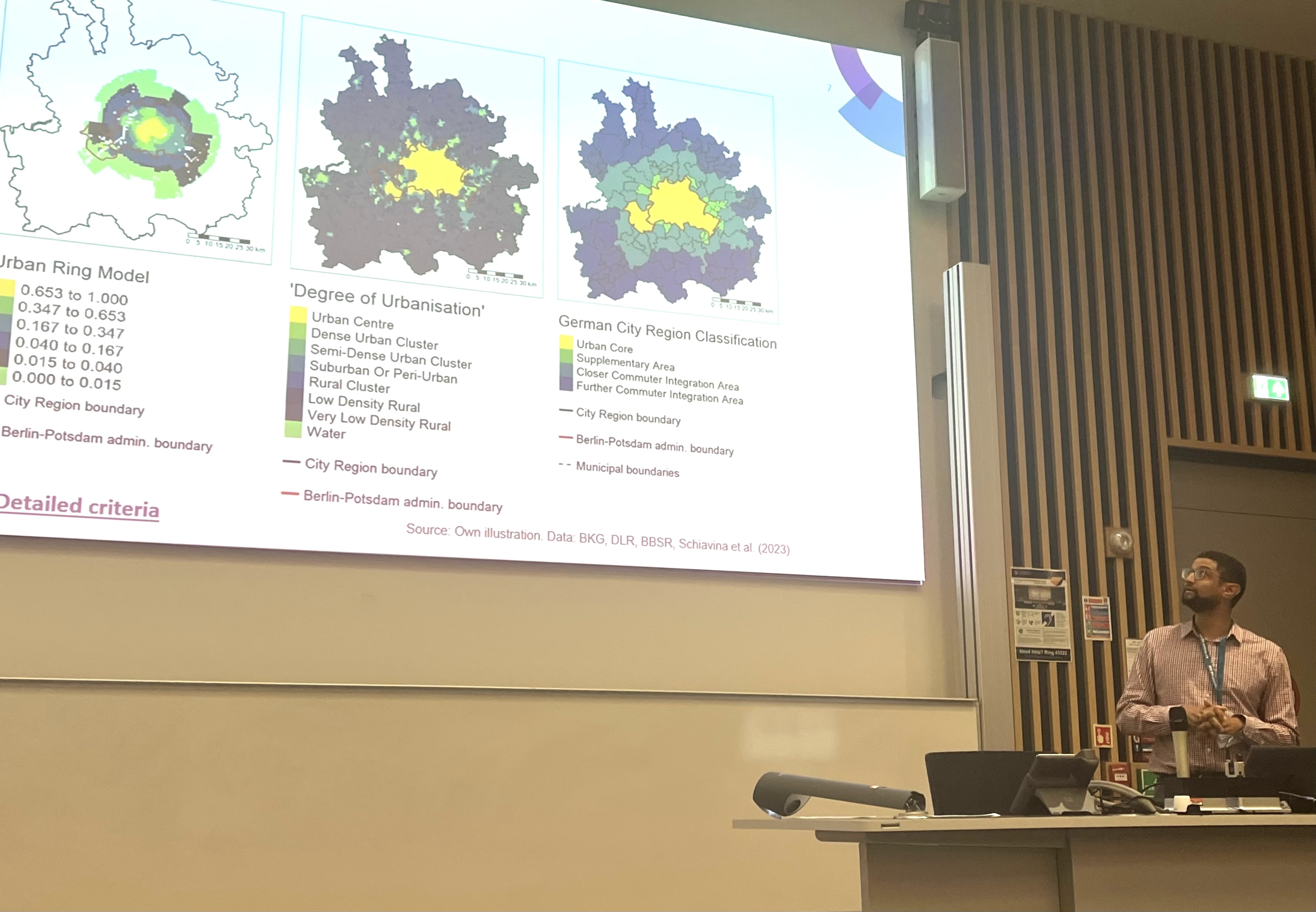
We were pleased to present the 2025 Robin Flowerdew Prize to Tamilwai Kolowa from the Federal Institute for Population Research, for the presentation “Is Germany experiencing urban or suburban growth? Contrasting three different urbanisation classifications.”
The research offered a compelling exploration of how varying urban gradient classifications influence our understanding of population change in Germany between 2011 and 2022. Tamilwai’s work highlighted that while urban areas have consistently grown faster than suburban ones, the degree and spatial distribution of this growth depend heavily on the chosen classification. The study provides valuable insights for refining global urban gradient frameworks and enhancing cross-national analyses of urban and suburban dynamics.
- Email: Tamilwai.Kolowa@bib.bund.de
- LinkedIn:Tamilwai Kolowa, Bundesinstitut für Bevölkerungsforschung, Earth Observation Research Cluster-UniWü, German Aerospace Center (DLR)
- X (Twitter): @DLR_en
- Bluesky: tamilwhy.bsky.social
Session Presentations
All presentations showcased exciting and innovative methods on important and timely topics, highlighting the creativity and rigour of emerging scholars in quantitative geography. The QMRG committee and session organisers thank all presenters for their work and are pleased to share an overview of the session’s other talks below.
Emiliano Beltran Alipio (Geographic Data Science Lab, University of Liverpool)
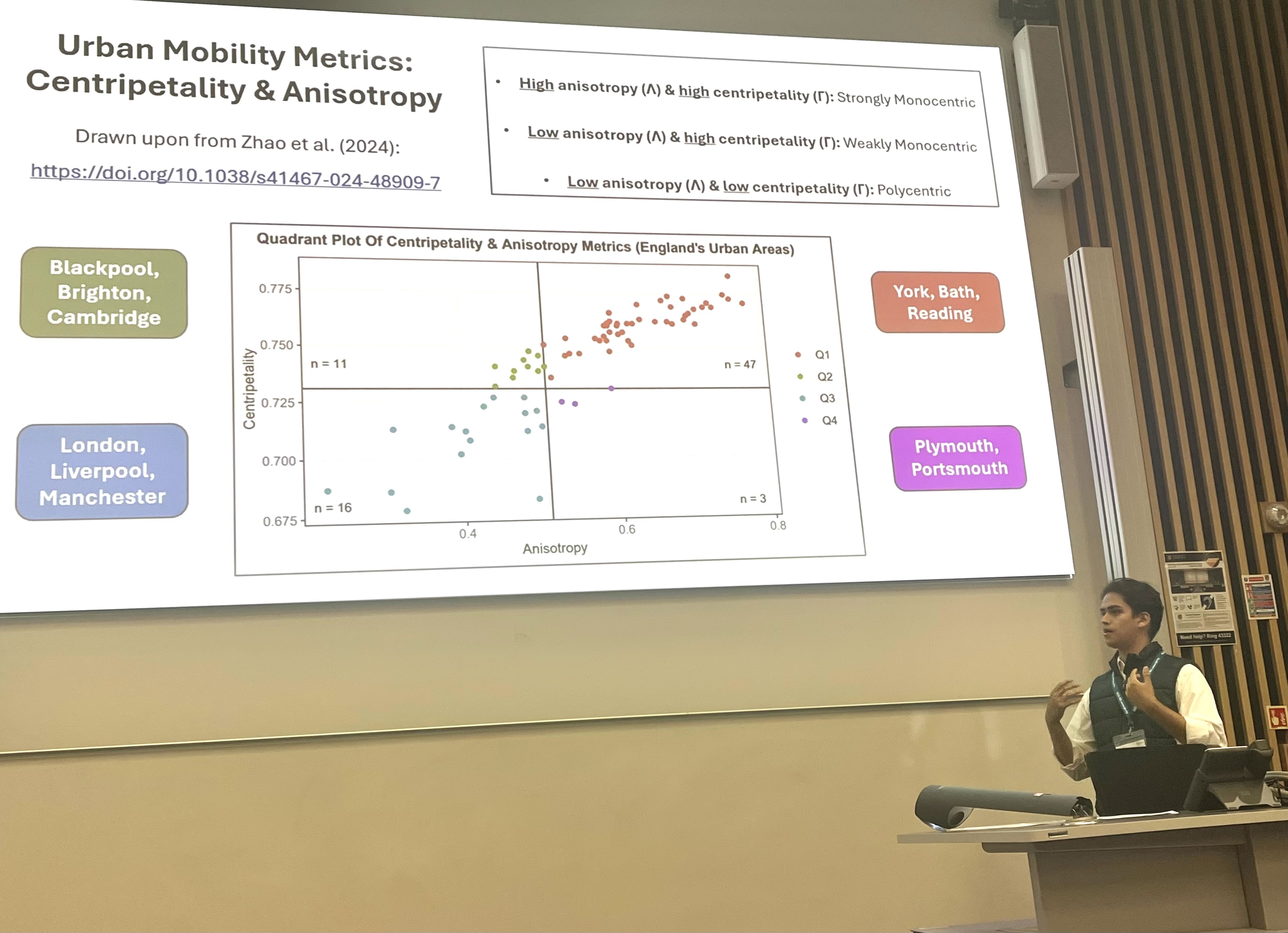
Emiliano Beltran Alipio’s presentation outlined an ongoing research project that examines how the spatial organisation of urban activities influences the spread of infectious diseases in densely populated areas. Drawing on insights from the COVID-19 pandemic, the project seeks to examine whether monocentric or polycentric urban forms are more resilient to contagion.
The proposed framework combines mobile phone mobility data, COVID-19 surveillance records, and regression modelling to analyse how urban structure and human movement shape transmission dynamics. The research aims to develop a conceptual approach for understanding how urban design can enhance public health resilience.
Contact and links
- Email: E.Emiliano-Beltran-Alipio@liverpool.ac.uk
- LinkedIn: Emiliano Beltran Alipio
Matt Whearty (CASA, University College London)
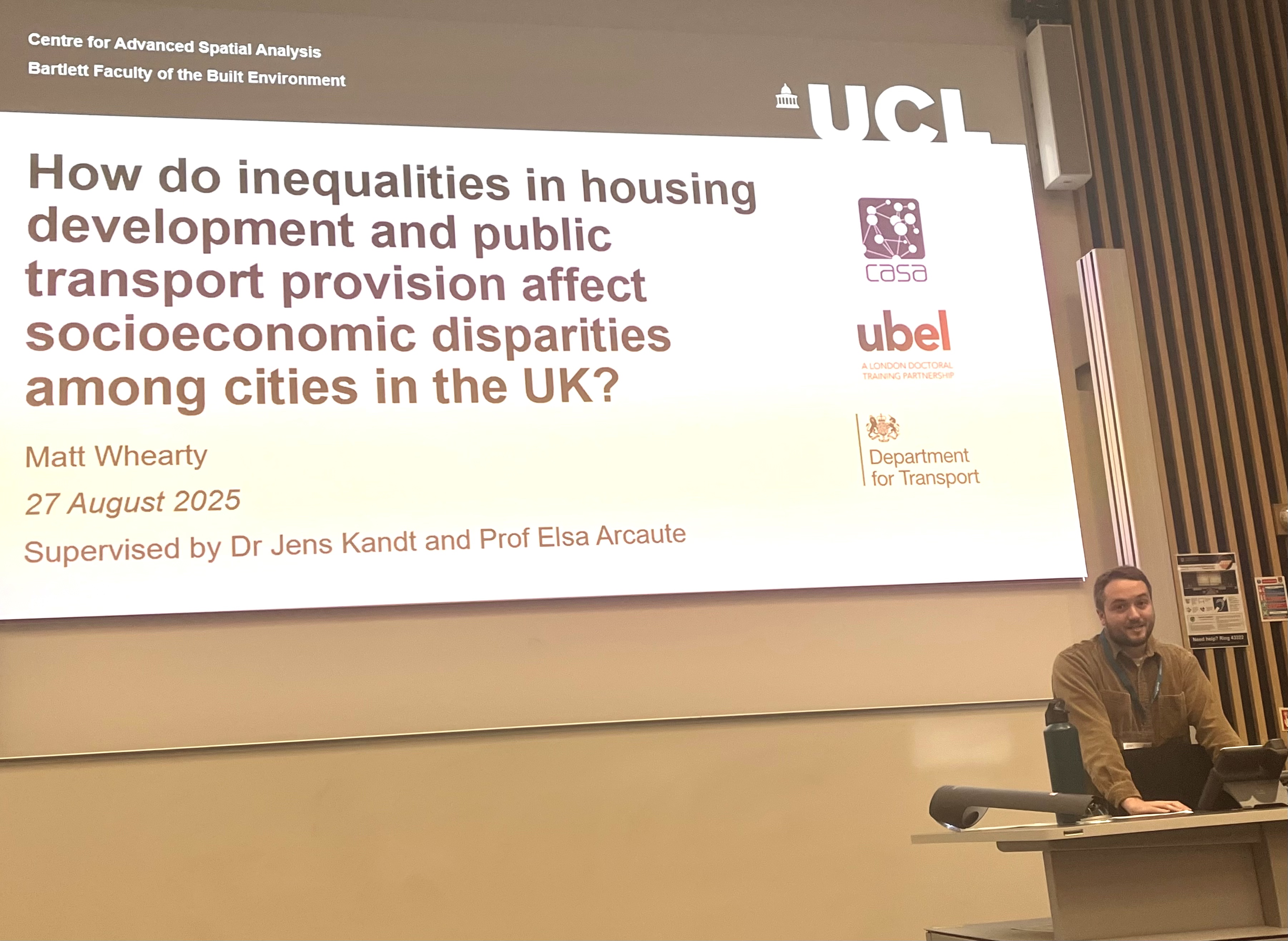
Matt Whearty’s presentation discussed his ongoing research into how inequalities in housing and transport provision shape the geography of productivity across UK cities. By linking agglomeration theory with novel spatial datasets, his project aims to build a clearer framework for analysing regional disparities in urban economic performance.
The presentation outlined a conceptual model connecting housing development, transport accessibility, and labour market outcomes, and reflected on the data challenges that accompany efforts to measure long-term spatial inequalities in the UK context. His work contributes to a growing conversation on how spatial data and planning evidence can inform more balanced regional development policies.
Contact and links
- Email: matthew.whearty.24@ucl.ac.uk
- LinkedIn: Matt Whearty
- X (Twitter): @MattWhearty
Rui Wang (King’s College London)
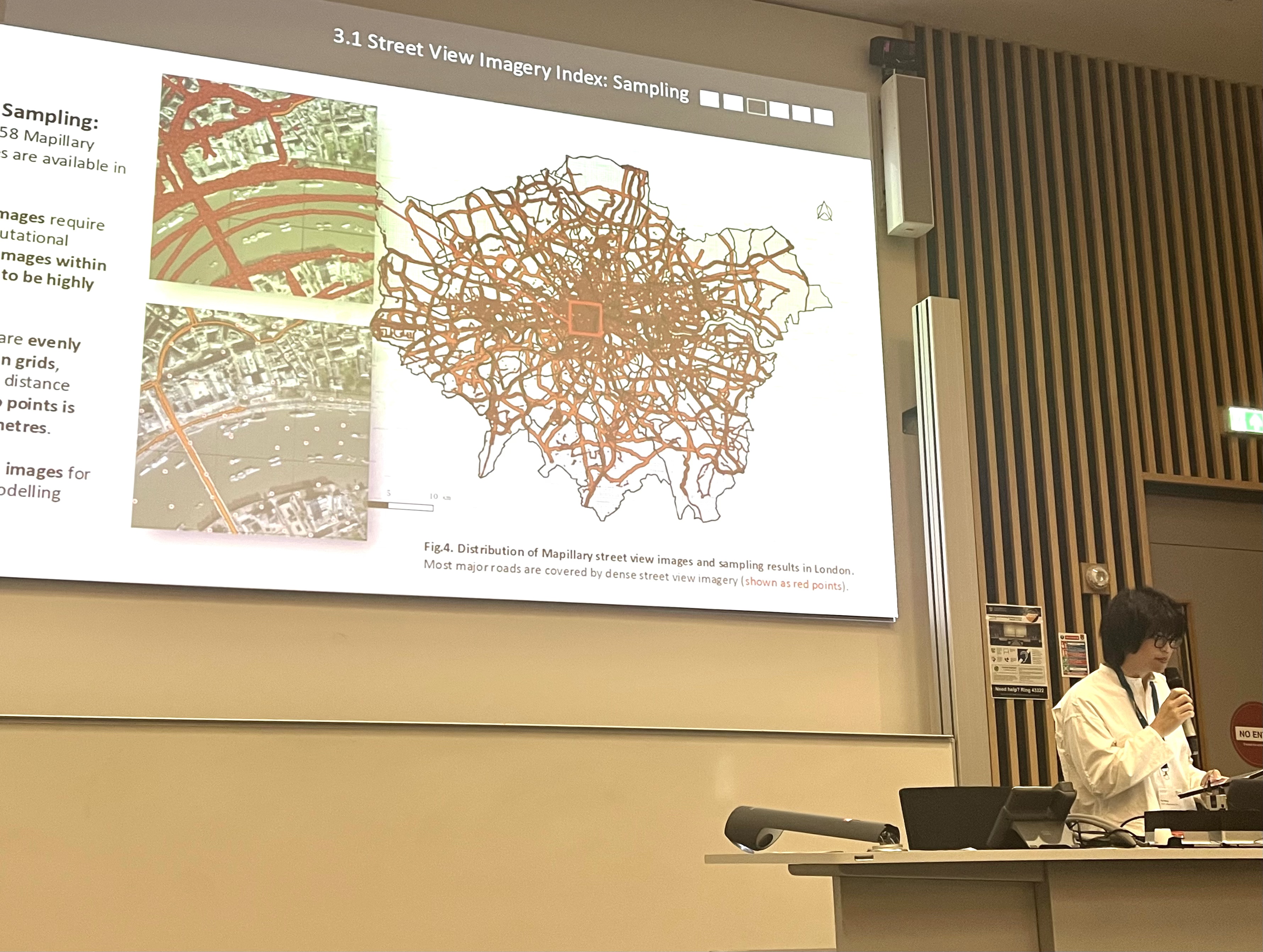
Rui Wang’s presentation introduced a machine-learning-based study examining how street environments influence the spatial distribution of crime in London. Using open-access volunteered street view imagery (Mapillary), census data, and night-time light data, the study applied kernel density estimation and ensemble regression models (with CatBoost performing best) to explain around half of the variation in crime density.
SHAP-based interpretability analysis revealed that building density, pedestrian activity, and lighting levels are key factors influencing theft and violent crimes, with distinct effects across central, inner-east, and suburban areas. The research provides new insights into the relationship between urban environments and crime and offers data-driven support for more targeted urban safety management.
Contact and links
- Email: rui.12.wang@kcl.ac.uk
Fangyuan Li (King’s College London)
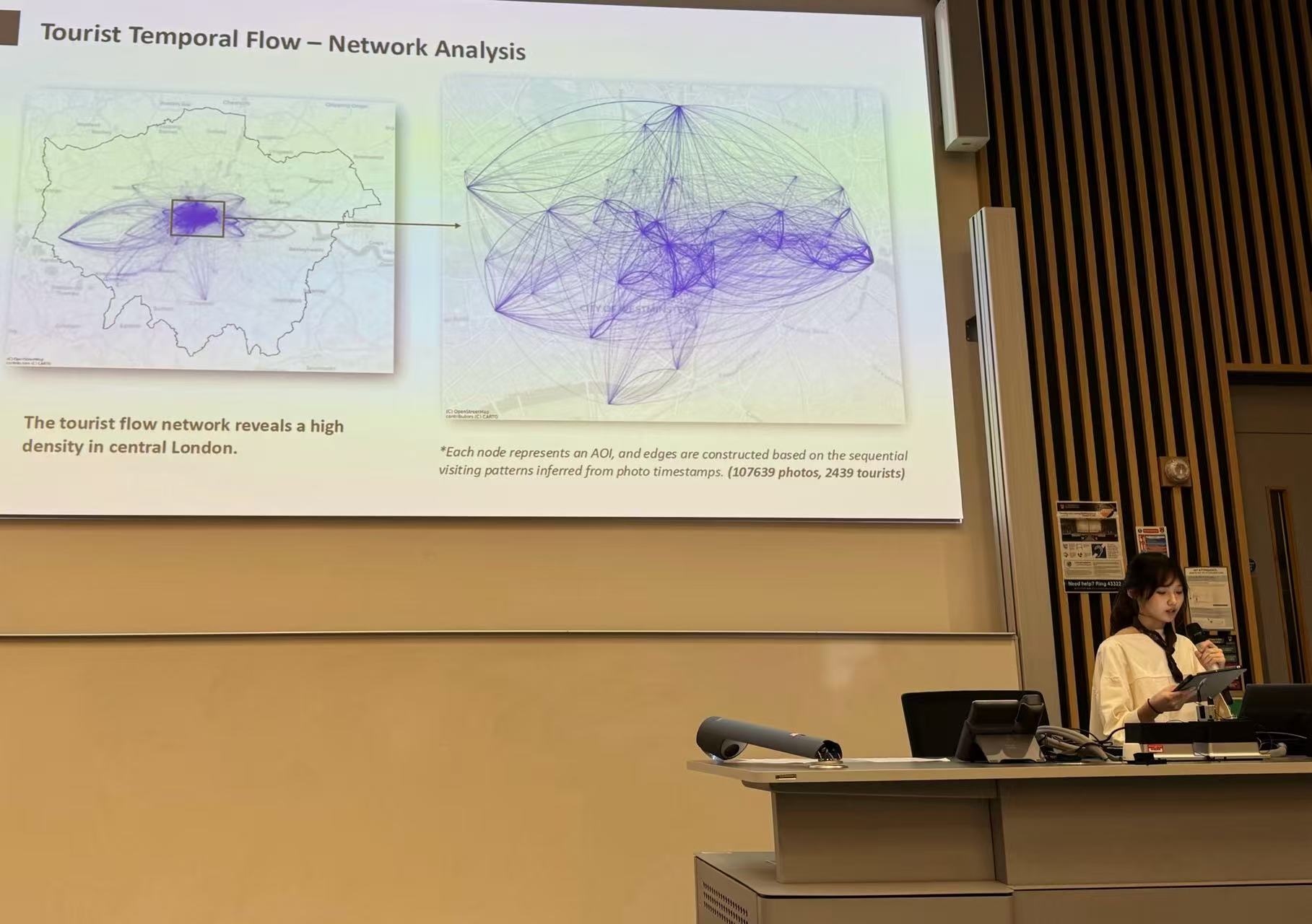
Fangyuan Li’s presentation introduced her early-stage research on how tourist activity shapes urban housing markets through spatial and data-driven analysis. Using geotagged Flickr photos from London, she applied machine learning to distinguish tourists from residents and mapped key hotspots and mobility flows.
By combining these insights with Airbnb and housing transaction data, her study used spatial regression models (GWR and MGWR) to explore how tourism intensity and short-term rental patterns potentially influence local housing prices. The findings reveal notable spatial heterogeneity, offering insights into how tourism dynamics and short-term rentals may reshape housing affordability and urban development in London.
Contact and links
- Email: fangyuan.li@kcl.ac.uk
- X (Twitter): @fangyuan_li225
Looking Ahead
We were delighted to host such an engaging session and thank all presenters and attendees for their contributions. We look forward to seeing the continued creativity and innovation that quantitative geographers will bring to future RGS-IBG conferences. Please reach out to any of our participants to discuss their work further!